Inventory & wheel
Measure available parts. Qualify one restrained wheel, its encoder, current limit and controller. Mock up the small frame.
Active direction · 28 September 2026
A small robot that balances, drives and adjusts its height. Built around the parts we have and a budget we can finish within.
Selected hardware · simulation evidence · physical tests pending01 / The smaller machine
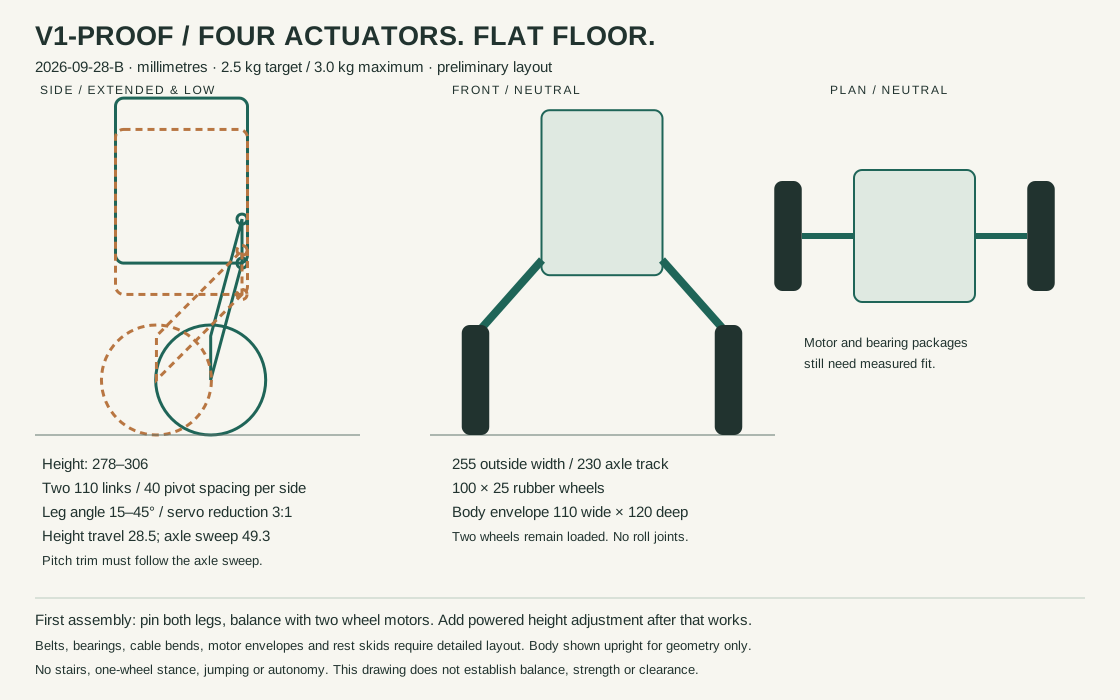
Small gearmotors at the wheels. Simple parallel links and reduced servos at the legs. Change the pose to inspect the proposed envelope.
Upright geometry only. The drawing does not simulate balance or validate component fit. Dimensions in millimetres.
Explore the assumptions
3:1 reduction · 60/40 wheel load split · assumed 85% transmission efficiency. Static load only; mounted testing is still required.
Equations, mass budget and limits ↗The tradeoff: height adjustment also moves the axle about 49 mm fore/aft. Measure the center of mass and pitch trim at each pose. Start with the legs pinned; qualify powered motion after balance works.
Mobility / new evidence
Replay closed-loop 3D trials and inspect the full parameter sweep, including failures. Hardware choices and physical acceptance tests are now explicit.
Drive it in the 3D sandbox ↗ · Selected motors, drivers, controller and sensors ↗ · Physical test protocol ↗
02 / A hard limit
Replacement allowances are included until reusable parts are confirmed. Every stage shares this budget.
| Allocation | Cap |
|---|---|
| Total planned ceiling | $900 |
03 / Build in useful steps
Measure available parts. Qualify one restrained wheel, its encoder, current limit and controller. Mock up the small frame.
Build both wheel channels. Prove balance and slow manual driving with the legs mechanically locked.
Test one reduced-servo leg under load. Then qualify slow, synchronized height changes with both wheels down.
Run balance, drive, height and fault trials. Finish a ten-minute session within measured mass and cost limits.
60-second balance in 9 of 10 starts. Five controlled drive sequences. Ten height cycles with at least 25 mm measured travel. Tested fault handling and a ten-minute mixed session. Full acceptance criteria ↗
Preserved / out of the current scope
Earlier drawings, actuator studies and simulations remain available. Their requirements do not apply to V1-PROOF, and this chassis has no promised stair upgrade path.