PARKED STAIR-V1 — 2026-09-28. Preserved planning history. V1-PROOF now governs active work.
Hux#
Early R&D for a wheeled biped: two legs that end in driven wheels.
North star: climb and descend stairs by stepping one wheel at a time. Design riser target is ~9.5"; actual stair geometry must be measured. V1 finish line (2026-09-27, R37): one 9.5" step, 9 of 10 attempts, from a standstill. Pace is a brisk walk (1.5 m/s top, 1.0 cruise); V1 terrain is flat + 1" sills + ~20° slopes. Direction and reasoning: docs/decisions.md.
This repo is the source of truth for Steve Barrett's Hux project. It is a docs-and-layout scaffold — not a finished robot.
Current engineering review (2026-09-28): head and leg audit reopens the stair architecture and procurement. Earlier review (2026-09-23): real-world validation audit checks geometry, CoM, loads, contacts, and controls. The combined stair drawings exceed spatial reach, and true one-wheel balance remains unproven. Includes reproducible calculations and a bench-test sequence.
Research first. Study James Bruton / XRobots, Hattori, and Steve's inspirations (Roadrunner, FrRonconi student balancer, Build Some Stuff / Serra, Tazer, Stompy) before hardware. Do not vendor upstream trees yet. RobotX is GPL3 — that conflicts with Hux's MIT if we adapt code; Steve decides, we do not relicense. Packet: docs/research/.
Decisions live in docs/decisions.md. Merge docs PRs promptly; keep main current; log each merge there.
Current engineering status — 2026-09-28#
No components purchased. The existing stair design is not ready for an actuator order. Steve asked to fix the legs to justify the actuator cost; controlled single support and a complete reachable step are the gate. A successful short hop is insufficient.
Start with the head and leg engineering review, archived engineering page, H1 dimensioned head layout, and revised BOM.
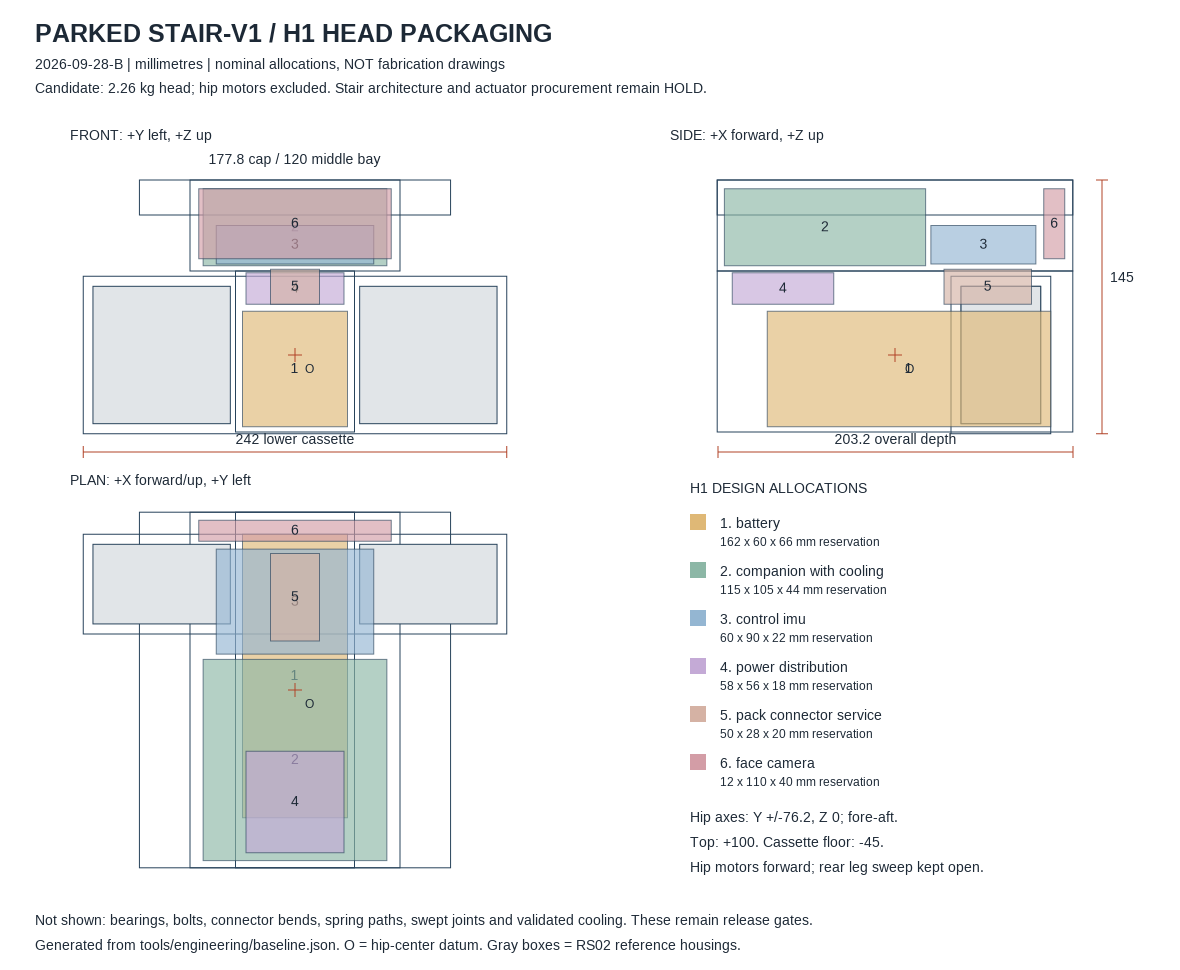
| Item | Current state |
|---|---|
| Head | H1 revision B: 203.2 mm depth, 120 mm middle bay / 177.8 mm top cap, 242 lower cassette; top 100 mm above hips. Itemized 2.26 kg estimate, no pack=CoM assumption |
| Compact legs | 8.5-inch links fit a nominal 24-inch height with H1, but fail 14/91 step samples |
| Alternative geometry | About 26-inch height, 9.5-inch links and 120 mm wheel-center track throughout the step: 810 interpolated reach/clearance/width checks pass nominally; mechanism, dynamics and thermal duty remain open |
| Contact / support | Hip + ankle roll with finite-width wheel contacts under investigation; passive pitch-level carrier unresolved. Ten powered axes is a candidate, not a validated fix |
| Actuators | Old RobStride set reopened. New gravity demands exceed hip-roll, hip-pitch and knee stationary references; reduction/alternate selection needs mounted tests |
| Electronics | 8S retained conservatively; 60-V-input regulator class and regen handling. Three classic-CAN buses with mixed update rates |
| Compute | Portable control core → CAN MCU → Linux companion architecture retained. No firmware implementation yet |
| Procurement | None ordered. Full candidate allowance $2,236–3,498 before shipping/tax; no full-set release |
| Legacy drawings / simulator | Preserved, prominently marked as the old eight-axis experiment; not a digital twin of the proposed mechanism |
Numerical sources: tools/engineering/baseline.json and bom.json. Regenerate results, head SVG, engineering page and BOM with python3 tools/engineering/review.py --write; run the physical-invariant tests with python3 tools/engineering/test_review.py. The old model's npm test also includes these tests and still rejects its stair candidate.
How it is supposed to work#
Balance on two wheeled legs for teleop. Redesign and validate the lateral support mechanism before stair work. The intended cycle is: lift one wheeled leg → balance on the planted wheel → place the raised wheel on the next tread (~9.5") → plant → repeat.
Repo layout#
docs/         requirements, decisions, vision, research, mechanical, electronics, software, checklists
NOTES.md      working notes and first milestones
cad/          dimensioned candidate layout and vendor references; no released custom parts
tools/engineering/       numerical candidate, static screen, mass model, budget and tests
tools/living-drawings/   engineering review plus legacy drawings (index.html), 3D sandbox (sim.html), data flow (flow.html), software (software.html), hardware (hardware.html), media (media.html)
art/          exploratory concept renders and rough meshes — not CAD
firmware/     FC / embedded bring-up (empty)
software/ companion compute — Pi cameras / pathfinding (empty)Docs#
- Decisions — dated log from #1 onward; standing merge rule
- Research — research-first stance, XRobots shortlist, inspiration shares, actuator trade, study plan (Phases A–D)
- Requirements — hard / soft requirements, candidate hardware, no-spend rule
- Vision — stair gait, split-brain intent, lessons to steal
- Mechanical — H1 head allocation, compact versus taller leg studies, contact mechanism and load gates. Historical leg math: research/leg-geometry.md
- Electronics — 8S, power protection, CAN MCU and proposed ten-node mixed-rate bus schedule
- Minimum electronics — P0–P5 class list (no SKU, no new spend)
- Current inventory (updated after this archive) — this snapshot recorded no confirmed Hux purchases or orders; later V1-PROOF orders and reuse confirmations are tracked at that link.
- BOM — complete candidate allowances, unresolved selection gates and a staged bench sequence; no released shopping cart.
- Sheet 1 — V1 layout — the first 2D sheet (R23): side, front, plan and stroke at the historical geometry, drawn from the model files; roll axes, hip band, leg plane, actuator placement, the pack, the landing target; what it settles and what Sheet 2 owns
- Sheet 2 — tubes, fittings, spring, hub, wires — what the leg is made of: carbon tube cuts and loads, fittings F1–F7, the knee pulley-spring and its torque curve, the hub section with the RS05 flush to the tire, the hip-band shell, the wire path
- Living drawings — side, top and front views of the historical leg, and the stair climb with its dynamics (momentum window, wheel catch, joint torques, sway). Play runs the climb in real time. Findings: research/stair-climb-dynamics.md
- 3D sandbox — drive the working model in 3D with rigid-body physics (Rapier + three.js): torque-limited joints, LQR balance, ride height (medium by default), spring legs with an impact hop, stumble catch, a planned one-wheel poise, stair / ramps / sills / curb / wet tile. A design toy, not the digital twin. Findings: research/sim-sandbox.md
- Data flow — command, power, motion, modes, and what waits until later
- Software — the 2026-09-25 bench-learning plan for the F765-Wing + Pi 5 (P0–P1). Superseded as the robot's stack by docs/software.md.
- Archived engineering page — head layout and procurement status. Legacy hardware page is historical; use bom.md for current numbers.
- Media — exploratory concept renders and rough meshes in art/. Look studies only. Not the drawings, not CAD.
- Shop capabilities — mill, lathe, bender, brake, bandsaw, solder, weld, breadboards (not parts)
- Software — four layers (CAN actuators, portable control core, CAN RT MCU, ROS 2 companion); layer-2 skeleton → blink → spin → four manual modes → cameras → perception
- Archived checklists — prefer these over fake finished stacks
Inspiration#
Study before we copy. Licenses differ; RobotX is GPL3.
- docs/research/xrobots.md — James Bruton / XRobots shortlist (RobotX, TallBalancer, SonicRobot, Stairs)
- Alex Hattori — STRIDE wheeled biped V2
- Steve's inspirations — RAI Roadrunner (lab), FrRonconi student two-leg/wheel balancer (maker-scale), Build Some Stuff / Serra (steal packaging; do not vendor), Tazer (learn from the mistakes), Stompy (CAD/reality match; not RL walking for V1)